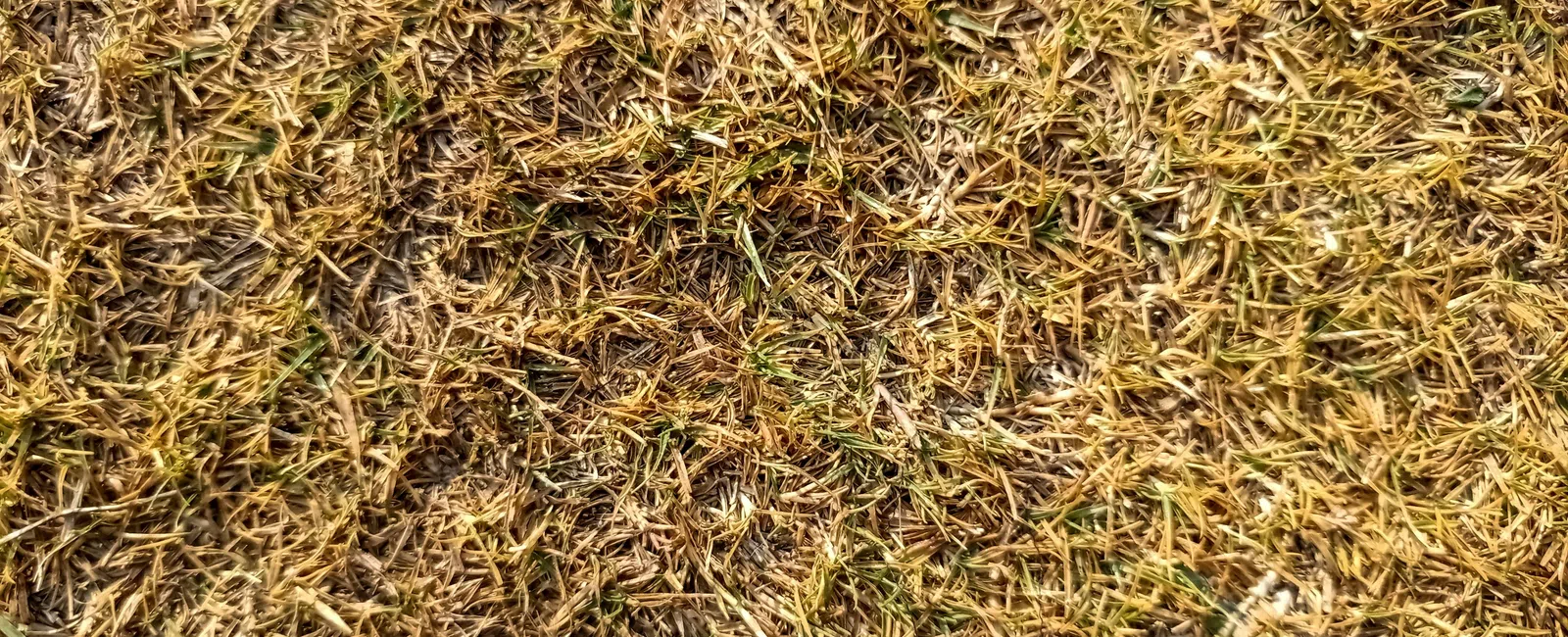
A lawn rarely goes yellow all at once. It starts as a pale strip along the driveway, a few faded patches in the side yard, or a general loss of color that you notice one afternoon and cannot remember when it began. The first instinct is to water more or put down fertilizer, and in South Florida, both can make the problem worse.
Read the Pattern Before Treating Anything
Where the yellow shows up tells you more than how yellow it is.
Irregular patches that grow week to week, especially in full sun or beside a sidewalk or driveway, point toward insects. Yellowing that spreads evenly across the whole lawn usually points to nutrition or soil. A strip along the foundation or the edge of the driveway that never quite greens up often traces back to the soil itself. Arcs or wedges that line up with your sprinkler heads point to irrigation. Small round spots with a darker green ring around them are almost always a dog.
Most lawns that come to us yellow have more than one of these going at once, which is why the pattern is where the diagnosis starts rather than where it ends.
Chinch Bugs Are the First Suspect in St. Augustine
Southern chinch bugs are the major insect pest of St. Augustine grass, and in South Florida they stay active year-round. They feed by piercing the grass blade, drawing out plant fluids, and injecting saliva that is toxic to the plant. The grass turns yellow first, then quickly turns brown, and the center of an older patch can go completely bare.
Damage tends to begin where the grass is already under heat or water stress, which is why it so often starts next to pavement that radiates heat back onto the turf. It is also why chinch bug damage is so commonly mistaken for drought. Homeowners turn up the sprinklers, the patch keeps spreading, and weeks go by while the population grows.
Excess nitrogen and mowing too short both make a lawn more attractive to chinch bugs, so the usual reflex of fertilizing a yellow lawn can feed the problem you are trying to fix. If the yellow patches are expanding along hot edges, a professional look before you apply any fertilizer can save the lawn a lot of ground. The insects themselves are tiny and black with white wings, and they hide in the thatch at the outer edge of a patch, which is why chinch bug damage keeps spreading outward while the center dies.
South Florida Soil Can Starve Grass of Iron
This is the cause most out-of-state lawn advice misses entirely.
Soils formed from limestone, marl, or seashells are alkaline, and alkaline soil is common across the mineral soils of South Florida and along the coast. Construction adds to it. Concrete, stucco, and other calcium-rich building materials left in the ground after a house is built raise the pH even further, which is why the band of grass along a foundation, pool deck, or driveway is often the palest part of the yard. High-pH irrigation water does the same thing over time.
On high-pH soil, iron and manganese become hard for the grass to take up even when they are present. The result is yellow blades on a lawn that may be getting plenty of nitrogen. The two deficiencies look alike, but they are not interchangeable: iron does not substitute for nitrogen, and it does nothing for yellowing caused by a nitrogen shortage. Treating one when the lawn needs the other leaves you with the same yellow lawn and a little less patience.
Changing the pH of strongly alkaline soil is very difficult and sometimes impossible, so the realistic goal is managing the grass on the soil you have rather than trying to rebuild it.
Nitrogen, Too Little and Too Much
A lawn short on nitrogen fades evenly, usually starting with the older blades. South Florida has a timing wrinkle that catches people out: many cities and counties in the region restrict nitrogen fertilizer during the summer rainy season to keep runoff out of canals and waterways, and the rules vary by municipality. A lawn that was fed poorly heading into that window can run low by late summer, right when growth and pest pressure are at their highest.
Too much nitrogen causes its own yellowing. Fertilizer burn shows up as yellow or straw-colored streaks and patches, often in lines where a spreader overlapped, and heavy feeding pushes soft, lush growth that chinch bugs favor. Getting the product, the amount, and the timing right on St. Augustine is a balancing act, and it has to stay inside the local rules.
Too Much Rain, Not Enough Irrigation
Water problems cut both ways here.
During the rainy season, a lawn that stays saturated loses root health, and waterlogged, stressed turf is where take-all root rot takes hold. By the time that disease shows yellowing above ground, it is usually well advanced underneath. Take-all root rot belongs to the same group of St. Augustine grass diseases as brown patch and gray leaf spot, and all three can begin as discolored grass.
In the drier months, the problem flips. Grass that needs water folds its blades, takes on a blue-gray tint, and holds footprints after you walk across it. When those symptoms show up in arcs or wedges, the cause is often a clogged, tilted, or broken sprinkler head rather than the schedule itself, and one zone can go yellow while the rest of the yard looks fine. An irrigation inspection finds those coverage gaps faster than adjusting run times ever will.
Problems Under the Surface
Some yellowing starts at the roots, where you cannot see it.
White grubs eat turf roots, so affected grass wilts, discolors, and in bad cases peels back from the soil like loose carpet. Mole crickets tunnel through the root zone and leave turf that feels spongy underfoot with raised ridges and thinning patches. Nematodes, microscopic worms that feed on roots, cause thin, weak, slow-growing turf that never responds to feeding or watering the way it should. Nematode populations in Florida typically peak in late April and early May, then again in late August and early September, which puts this time of year squarely in the window.
Root feeders are easy to misread as a nutrition or water problem because the above-ground symptom is the same: grass that cannot pull in what it needs. Knowing when grubs are active matters as much as knowing they are there.
Mowing Height and Shade
Keep standard St. Augustine varieties at 3.5 to 4 inches, and dwarf varieties at about 2.5 inches. Mowing lower than that scalps the grass, exposes the yellow lower stems, weakens the root system, and also raises chinch bug pressure. Dull blades shred the tips instead of cutting them, which leaves the whole lawn with a yellowed cast a day or two after mowing.
Shade matters too. Floratam, the most widely planted St. Augustine variety in the region, does not hold up in spots that get less than about six hours of sun a day. Grass under a maturing oak or along the shady side of a house will thin out and yellow no matter how it is fed.
Yellow Spots Where the Dog Goes
Small, round yellow spots, often with a ring of darker green grass around the edge, are nitrogen burn from dog urine. The concentrated center scorches the grass while the diluted edge acts like a dose of fertilizer. Female dogs and large dogs that empty their bladder in one spot tend to leave the most visible marks. These spots are cosmetic, but it's worth recognizing them so nobody treats the lawn for a disease it doesn't have.
Is Yellow Grass Dead?
Usually not. Yellow grass is stressed grass, and St. Augustine spreads by runners, so a lawn that is yellow but still anchored has a good chance of recovering once you correct the cause. Brown grass that pulls up with no roots attached, or patches with bare soil in the center, have gone past that point and generally need repair.
The catch is that recovery starts only once you address the right cause. Watering a chinch bug problem, adding iron to a nitrogen shortage, or fertilizing a lawn whose roots are being eaten just burns through another month of the growing season.
Getting the Diagnosis Right
A yellow lawn in South Florida is rarely a single problem with a single fix, and most of the expensive mistakes come from guessing. A proper inspection looks at where the yellowing is, checks the thatch and soil line for insects, pulls turf to inspect the roots, and walks the irrigation zones before applying anything. Royal's lawn care program combines fertilization, insect control, disease prevention, and weed control on a regular schedule, so the lawn is not fighting each of these battles one at a time.
At Royal Pest & Termite, every product we put down on a lawn is chosen to protect the turf while staying safe for kids and pets who play on it, the same standard that has kept us at 4.8 stars across 173 Google reviews. We are licensed, insured, and a member of the Florida Pest Management Association, and we offer free inspections and estimates across our South Florida service areas in Miami-Dade, Broward, and Palm Beach counties, backed by a guarantee with free call-backs between scheduled visits.
Call us today to schedule a free lawn inspection and get your St. Augustine green again while there is still growing season left.