Telling a Juvenile From an Adult
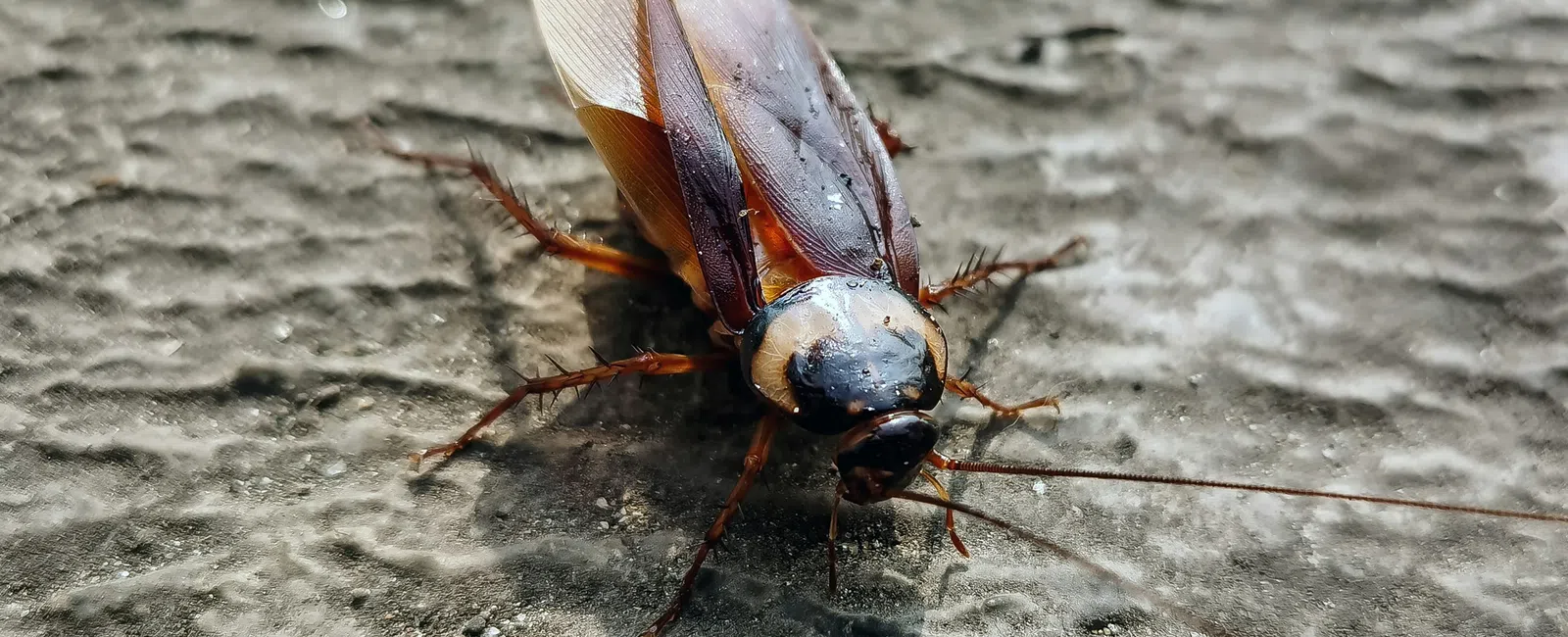
Young cockroaches, properly called nymphs, look like smaller versions of the adults of their species with two reliable differences. They have no working wings, carrying at most wing pads that enlarge as they grow, and they cannot reproduce yet. In American cockroaches, those wing pads become noticeable around the third or fourth molt, which gives you a rough age marker.
One stage throws people entirely. Every time a nymph sheds its skin, it comes out white and stays that way until the new covering hardens and darkens, usually within hours. Anyone who catches one in that window is convinced they have found an albino insect. It is an ordinary nymph at an awkward moment.
The Five You Actually Find Here
| Species | What the Juvenile Looks Like | Time to Adult |
|---|---|---|
| German | Dark brown to black, with distinct dark parallel bands running the length of the shield behind the head | About 60 days |
| Asian | Nearly identical to a German nymph, slightly smaller, with pale margins along the abdomen and spots down its midsection in later stages | Similar to German |
| American, the common palmetto bug | White at hatching, then grayish brown, then reddish brown with darker rear margins on each segment | 6 to 12 months |
| Australian | Wingless with light yellow spots across the top of the abdomen, turning mottled as it grows | 6 to 12 months |
| Florida woods, the true palmetto bug | Reddish brown to black, often with yellow margins on the thoracic segments in later stages | Around 150 days from egg |
Two things in that table are worth flagging. The Australian cockroach is the most common species found outdoors in southern Florida, though it tends to stay outdoors and only ventures in occasionally. Abundance overall runs differently: the German cockroach is the most abundant species in the state, with the American cockroach next. And the Florida woods nymph cannot yet produce the oily defensive spray adults are known for. The gland is present in the final juvenile stage but does not start producing until after the molt into adulthood.
The Florida Complication Nobody Warns You About
The Asian cockroach reached Lakeland in 1986 and has since spread through much of the state. It is so close to the German cockroach that entomologists cannot separate the two by eye with confidence; laboratory analysis is what actually confirms the species. The visible differences are marginal. Asian juveniles run a little smaller, their later stages show pale margins and spots along the abdomen, and the dark stripes behind the head are darker and more sharply defined.
Behaviorally, they could not be less alike. German cockroaches breed indoors, cannot fly in any useful sense, and stay in kitchens and bathrooms. Asian cockroaches are strong fliers, become active at sundown, are drawn to brightly lit areas and light-colored surfaces, live outdoors in shaded mulch and compost, and rarely establish indoors at all.
So the same small striped insect is either a breeding population inside your walls or a yard insect that flew toward your porch light at dusk. Appearance will not settle it. Where you found it, what time, and whether the numbers are climbing indoors will tell you.
What Gets Mistaken for One
Bed bugs cause most of the false alarms. Both are small and brown, but the shapes separate cleanly once you know what to compare. A bed bug is flat and broadly oval, close to seed-shaped, with short stubby antennae, and it never develops wings at any stage of its life. A cockroach nymph is longer than it is wide, carries antennae often as long as its entire body, has two small appendages at its rear end, and bolts when exposed. Bed bugs are slow by comparison.
Carpet beetle larvae are the other regular mix-up: stubby, visibly bristly, and creeping rather than darting.
What Finding One Actually Tells You
A nymph is better evidence than an adult, but what it proves depends on the species.
Nymphs cannot fly, and they have not traveled far from where they hatched. So finding one always means the source is close. If it is a German nymph in a kitchen or bathroom, close means inside the structure, and the arithmetic gets bad quickly: one egg case carries 30 to 40 eggs, and the young reach adulthood in roughly 60 days. A few becomes a lot inside one season.
If it is an Australian, American, or Florida woods nymph, close means harborage pressed up against the building. Mulch beds, leaf litter, palm boots, a damp strip along the foundation. The insects are living outside, and the route in is open, which is a different job with a different fix.
That is also why a technician pays more attention to one small dark nymph in a kitchen than to one large palmetto bug in a garage. The first suggests breeding on site. The second may be a visitor.
Why the Species Decides the Response
The work splits along the same line the identification does.
German cockroaches build populations in wall voids, appliance cavities, and cabinet corners, so the treatment happens inside and follows its own approach, which is why German cockroach treatment is handled separately from exterior perimeter work. Sorting out which roach species you have is the decision everything else depends on, and the palmetto bug identification markers cover the outdoor species you are most likely to meet as adults.
Given that two of the five cannot be told apart by eye even by specialists, this is not something to settle from a phone photo. Where juveniles are concentrated, whether an egg case is tucked in a cabinet seam, whether numbers are rising indoors or arriving nightly from outside, and which entry points are in use are questions answered by looking. A cockroach treatment aimed at the wrong species in the wrong place leaves the source untouched, and the young keep appearing.
At Royal Pest & Termite, every product we use in a kitchen or along a foundation is chosen to handle roaches while staying safe for kids and pets, the same standard that has kept us at 4.8 stars across 173 Google reviews. We are licensed, insured, and a member of the Florida Pest Management Association, and we offer free inspections and estimates across our South Florida service areas in Miami-Dade, Broward, and Palm Beach counties, backed by a guarantee and free call-backs between scheduled visits.
Call us today to schedule a free cockroach inspection and find out which species you are dealing with before it finishes growing up.