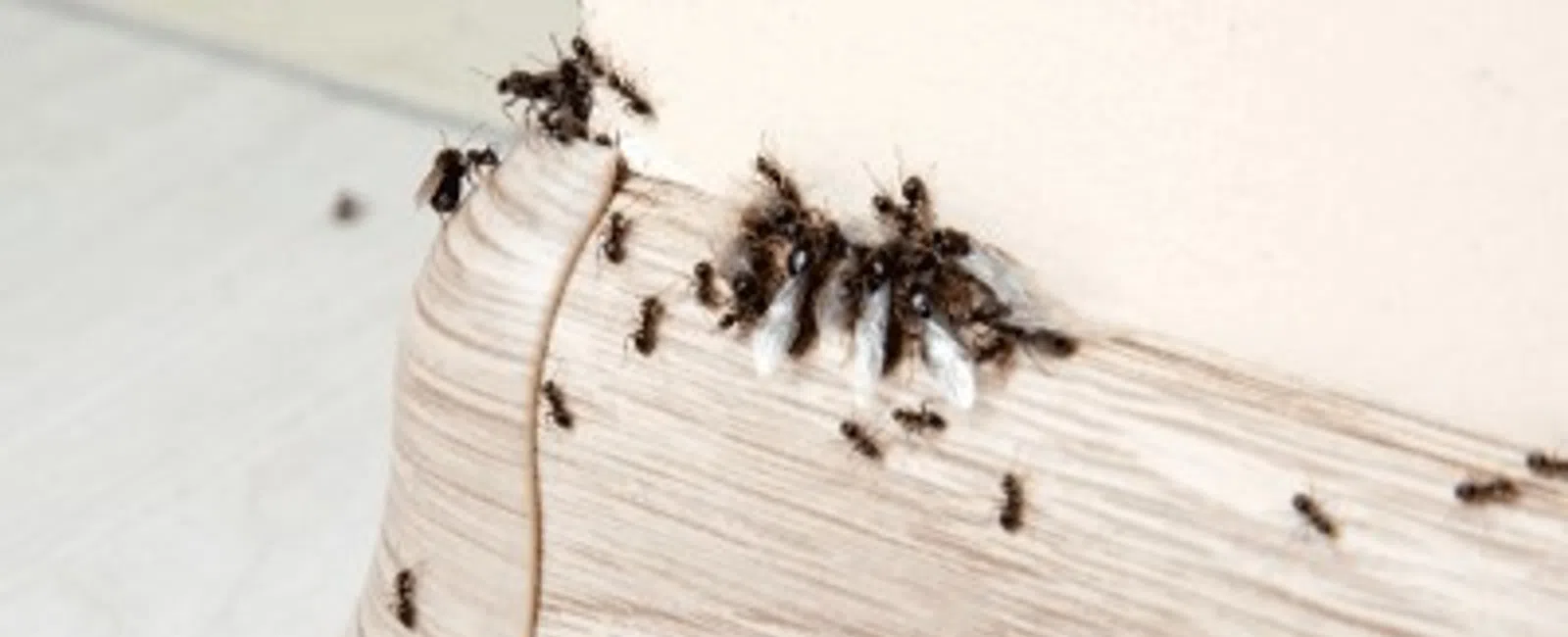
In South Florida, ants in the bathroom are usually telling you something about water, about the walls, or about a colony that is already closer than you think.
Water Is the Main Draw
Ants need water, and they will travel a long way for it. A bathroom is the most reliable water source in the house: a slow drip under the sink, condensation on the toilet tank and supply lines, damp grout, a wet bath mat, and a shower floor that stays wet for hours after use. During the dry months especially, that steady moisture pulls in ants that were perfectly happy outside all summer.
Humidity matters as much as standing water. Bathrooms with poor ventilation hold moisture in the air, the drywall, and the wood around the tub, and several of the ant species common here are drawn to exactly those conditions.
Food plays a smaller role, but it is there. Sweet or oily residue from toothpaste, mouthwash, lotions, and hair products, along with dead insects in drains and corners, gives foragers enough reason to keep a trail going once they have found the water.
The Walls Around Your Plumbing Are an Open Door
Most bathroom ants are not walking in from the yard. They are coming out of the wall.
Wherever a pipe passes through drywall or a slab, there is usually a gap around it, and those openings behind the vanity, under the tub, and around the toilet supply line connect straight into wall voids. For ants, a wall void next to plumbing is ideal nesting space: dark, protected, and damp. Ghost ants, in particular, nest in wall voids near plumbing and under sinks, and they are the species South Florida homeowners most often find in bathrooms. What looks like a handful of ants on the counter is often the edge of a nest a few inches behind the tile.
This is why wiping up the trail never seems to work. The ants you see are only a small part of the colony, and the part that matters is inside the wall.
Which Ant Is It?
The species changes what the sighting means, so it is worth knowing which one you are looking at.
Ghost ants are tiny, with a dark head and a pale, almost see-through abdomen and legs, and they move fast and erratically. They are the most common bathroom ant in the region, and ghost ants in South Florida give off a faint coconut smell when crushed, which is a quick way to tell them apart.
White-footed ants are small, under an eighth of an inch, black to brownish-black with pale yellowish-white feet. They nest in attics, wall voids, and under roof shingles; they are strongly attracted to sweets, and a single colony can hold anywhere between several hundred thousand and more than a million ants spread across connected satellite nests. They have been established in Miami-Dade, Broward, and Palm Beach counties for decades.
Pharaoh ants are tiny and yellowish and feed on sugars, proteins, oils, and insects. Like ghost ants, they spread by budding, where part of a colony moves off with its own queens to start a new nest, which makes them one of the hardest ants to control.
Florida carpenter ants are a different story, and they are the ones worth paying close attention to.
Big Ants in the Bathroom Can Point to a Leak
Florida carpenter ants are large, roughly a quarter inch to nearly half an inch long, with a rusty orange head and thorax and a black abdomen. They are most active at night, peaking around sunset and again near dawn, so many homeowners only see them after dark.
They do not eat wood. They nest in existing voids or excavate soft material, which means rotten, water-softened wood around a window frame, under a leaking tub, or behind a shower wall. They actively seek out rooms with plumbing leaks or around doors and windows. Large ants showing up in a bathroom repeatedly, especially at night, can be the first visible sign of water damage you did not know you had.
This is the point where a professional inspection matters more than a trip to the hardware store, because the question is no longer just where the ants are coming from. It is whether there is wet, damaged wood behind the wall that needs attention before it gets worse.
Ants With Wings in the Bathroom
Winged ants in a bathroom deserve a closer look. With Florida carpenter ants, winged reproductives emerging indoors during winter or early spring usually mean the nest is inside the structure rather than in the yard.
Winged insects near a bathroom window or light can also be termite swarmers, which are easy to confuse with flying ants and carry a very different level of risk. Termites have straight, beadlike antennae and two pairs of equal-length wings, while carpenter ants and termites differ just as clearly at the waist, which is pinched on an ant and thick on a termite. If there is any doubt, that is a sighting to have identified rather than swept up.
Why the Ants Keep Coming Back
Most bathroom ant problems that drag on for months have been sprayed.
Store-bought ant sprays are repellent. They kill the ants they touch and push the rest of the trail elsewhere, but they don't reach the colony, and with budding species like ghost ants and pharaoh ants, the disturbance can cause the colony to split into several new nests. A single problem behind the vanity turns into activity in the kitchen, the laundry room, and the other bathroom a few weeks later. Repellent residue also contaminates any nearby bait, so ants refuse to feed on it.
Effective control depends on the ants carrying treatment back to the nest and sharing it through the colony, including the queens and brood. White-footed ants add another layer of difficulty because workers do not share food with nestmates the way most ants do, so the approach has to account for species. That is why identification comes first, and why professional ant control starts with an inspection rather than a spray.
What a Proper Inspection Looks For
A bathroom ant problem gets solved at the source, and finding the source takes looking in places most homeowners cannot easily reach. An inspection traces the trail through wall voids and pipe penetrations, identifies the species, checks for moisture and softened wood around the tub, toilet, and vanity, and follows the colony outside to see whether it is feeding on landscaping or nesting in the structure. It also confirms whether a sweet-loving species like the ones behind most sugar ant problems is foraging from outdoors or has moved in for good.
At Royal Pest & Termite, every product we use inside a bathroom, around plumbing, or along a foundation is chosen to eliminate the colony while staying safe for kids and pets, the same standard that has kept us at 4.8 stars across 173 Google reviews. We are licensed, insured, and a member of the Florida Pest Management Association, and we offer free inspections and estimates across our South Florida service areas in Miami-Dade, Broward, and Palm Beach counties, backed by a guarantee with free call-backs between scheduled visits.
Call us today to schedule a free ant inspection and find the nest behind the wall before the dry season pushes the rest of the colony indoors.