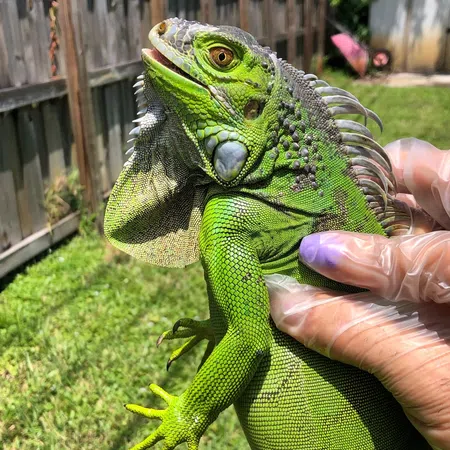
Green iguanas burrow under sidewalks, seawalls, and foundations in Miami-Dade, Broward, and Palm Beach Counties, and a resident animal will not abandon a reliable food source or a warm canal bank on its own. How to get rid of iguanas is a professional job built around live trapping and lawful removal, not a weekend project with a garden hose or a bottle of repellent. Store sprays might move an animal for an afternoon. The burrow, the droppings, and the next nesting cycle stay put.
Iguana Damage in South Florida Yards
Green iguanas are an invasive, nonnative species that now live along canals, in suburban yards, and in trees across South Florida. Adults climb, swim, and dig. The damage that brings most service calls is not a single lizard on a fence. It is the hole under a seawall, the collapsed edge of a sidewalk, and the pile of droppings on a pool deck in cities such as Miramar, Davie, and Boca Raton.
Typical signs include:
- Fresh burrows along seawalls, canal banks, sidewalks, and slab edges
- Chewed or stripped landscape plants, especially hibiscus, orchids, roses, and vegetable beds
- Droppings on docks, porches, pool decks, and in the water of a swimming pool
- Repeated sightings of the same large lizards on roofs, screens, or patio walls
Burrows weaken the soil around hardscape. A seawall or sidewalk can settle or crack once the voids underneath wash out. Droppings are more than an eyesore. Florida wildlife officials warn that iguana feces can spread Salmonella when the material contaminates water or outdoor surfaces. A household with children or pets using a pool deck has a health problem, not just a landscaping problem, and that risk is one more reason to leave removal to a licensed trapper.
An iguana that only crosses a canal bank and leaves is not the same case as a burrow already undermining a wall. The second case is the one that needs professional iguana control.
Why Store-Bought Fixes Fail
Garden centers sell granules, sprays, and ultrasonic gadgets marketed as iguana repellent. Most of those products promise a scent or a taste the animal will avoid. In practice, a hungry green iguana returns to fruit trees, flowers, and warm concrete once the smell fades. Chasing an animal off a seawall, spraying it with a hose, or hanging shiny objects might interrupt a visit. None of those tactics collapses a burrow or stops a new animal from moving into the same hole the next morning.
Catch-and-release is a worse idea than a weak spray. Captured iguanas cannot be relocated and released at another site in Florida. Moving a live animal down the canal or to a vacant lot can violate state rules and simply shifts the damage onto a neighboring property. Leaving a live iguana in a homemade cage creates a second problem: a permit is required to possess live captured green iguanas for eradication and control. A well-meaning homeowner can end up with a legal issue and a stressed, defensive animal in a garage.
Poison baits and unapproved chemicals add risk for dogs, cats, and children, and they still leave a burrow system in place. Iguanas also bite and scratch when cornered. A struggle with a large adult is a medical risk, not a control plan.
How to get rid of iguanas is not a matter of buying a stronger spray. The reliable method is professional live trapping, followed by lawful removal, so the property is not just empty for a day.
Florida Rules That Shape Removal
The Florida Fish and Wildlife Conservation Commission treats green iguanas as a prohibited, invasive species. State rules encourage removal from private property, and they also set limits on what happens after an animal is caught. Captured iguanas cannot be relocated and released elsewhere in the state. A permit is required to possess live captured green iguanas for eradication and control.
Those two points are why how to get rid of iguanas in Florida is not a simple trap-and-dump chore. Live animals have to be handled under the rules that apply to prohibited reptiles. A licensed professional who performs this work already operates inside that framework. The practical path for a household that cannot handle a large, defensive reptile is to hire that kind of trapper rather than improvise a capture.
How to Get Rid of Iguanas Using Live Trapping
A professional visit starts with a walk of the property: burrows, basking spots, travel paths along fences and canal edges, and plants that keep drawing animals back. The crew then uses live traps placed on those paths, checks them on a schedule, and removes captured iguanas in line with Florida rules. The point of that sequence is permanent removal of the animals that already live on the lot, not a one-time scare.
Good iguana control also looks at the conditions that invited the problem. Fruit on the ground, dense vegetation against a seawall, and open burrows will attract a replacement animal if nothing else changes. A technician can review those conditions during the inspection. The capture and removal work stays with the crew. There is no safe, legal shortcut that lets a homeowner skip that step and still expect the iguanas to stay gone.
Iguanas on a roof or inside a screened enclosure follow the same logic. The animal has to be captured and removed, and the access or attractant that put it there has to be addressed by someone who can do the work lawfully. That combination of inspection, live trapping, and lawful removal is the method used for iguana work on South Florida homes, and it sits under rodent and wildlife removal programs that already cover rats, raccoons, and squirrels.
Professional Iguana Trapping in South Florida
Royal Pest & Termite has provided pest, rodent, and wildlife service in Miami-Dade, Broward, and Palm Beach Counties since 2014. The Miramar company is licensed and insured. For how to get rid of iguanas, technicians use live trapping and lawful removal rather than poison or relocation. Inspections are free. If pests return between scheduled visits, the company returns at no additional charge. Call 754-800-5284 or contact the office to schedule a free inspection.