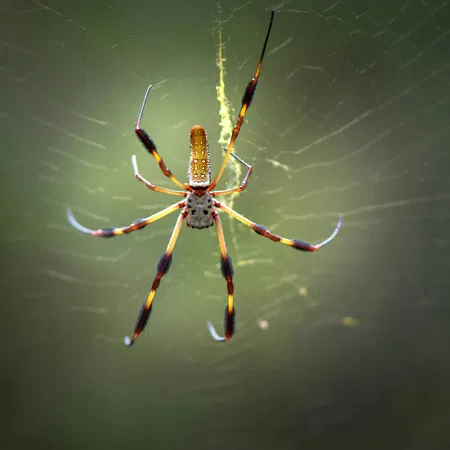
A banana spider is the golden silk orb weaver, and the females strung across South Florida walkways in September and October have bodies up to 1.5 inches long with a leg span close to 3 inches. The silk is yellow, the web can stretch 3 feet or more, and the bite is milder than a bee sting. The spider itself is rarely the problem. The web is, because it reappears across the same pool gate or front path within a day or two of being knocked down.
What A Banana Spider Actually Is
In Florida, banana spider almost always means Trichonephila clavipes, the golden silk orb weaver. The name comes from the yellow tint of the silk, not from the fruit. The same nickname is also used for the Brazilian wandering spider, a ground-hunting species from Central and South America that occasionally turns up in shipped produce and carries venom that can require hospital treatment.
The two are unrelated, and telling them apart takes one look. The spider in a South Florida yard builds a large, wheel-shaped web between trees or along a fence and stays on it. The wandering spider builds no web, hunts on the ground, and has no established population in Florida. A large spider hanging head-down in a golden web is the orb weaver, and nothing about it calls for alarm.
Golden silk orb weavers live across the Southeast, and Broward, Miami-Dade, and Palm Beach counties sit in the warmest part of that range, so the season here runs longer and the webs get bigger.
How To Identify A Banana Spider
An adult female has a body between 1 and 1.5 inches long, not counting legs, and she is the one you notice. The abdomen is long and cylindrical, orange-brown to olive with rows of pale yellow or white spots. The front section of the body is covered in silvery white hair. The legs are dark with yellow or orange bands at the joints, and the detail that settles the identification is the brush of dark, feathery hair on the first, second, and fourth pairs of legs.
The males look like a different animal. They are about a quarter inch long, plain dark brown, and often sit at the edge of a female's web in groups of two or three, waiting.
Three features confirm what you are seeing:
- A wheel-shaped web of visibly yellow or gold silk, often 3 feet across, with loose tangles of barrier threads on one or both sides.
- A spider hanging head-down near the center with its legs grouped in pairs so it looks like it has four legs instead of eight.
- Tufts of dark hair on the leg joints, which no other large web builder in South Florida has.
Banana Spider Vs. Joro Spider Vs. Garden Spider
Two other large, yellow-marked orb weavers get mistaken for banana spiders. The joro spider is a close relative that became established in north Georgia and has been spreading through the Southeast; reports in Florida remain scattered. The yellow garden spider is native and common in local yards. The abdomen shape and the web settle it.
A joro spider has a rounded abdomen that is bright yellow with blue-gray bands and a red underside, and its black-and-yellow banded legs have no hair tufts. The silk is golden like a banana spider's, and the web is often layered.
A yellow garden spider has a broad, oval abdomen in a bold black-and-yellow pattern, with legs that are black near the tips and yellow or red near the body. Its silk is white, and the web carries a thick white zigzag down the middle that a banana spider's web never has.
Do Banana Spiders Bite, And Are They Venomous
Banana spiders are venomous in the technical sense, as nearly all spiders are, but their venom is not medically significant for people. Bites are uncommon and happen when a spider is pressed against skin, usually by someone walking face-first into a web or reaching into hedges while gardening. The spider's first response to a disturbance is to shake the web or drop to the ground, not to bite.
When a bite does happen, the result is local redness and mild pain that most people compare to a bee sting or less. Symptoms fade within a day or so. Washing the area and applying a cold compress is enough for most bites, and medical attention is only needed for signs of an allergic reaction or infection.
The word poisonous gets attached to banana spiders online, but poisonous describes something harmful when eaten or touched, which does not apply here. The two South Florida spiders whose bites do warrant a doctor's attention are the black widow and the brown widow, and both hide in sheltered spots rather than hanging in open webs.
Why Banana Spider Webs Keep Coming Back
The life cycle explains the timing. Spiderlings hatch in spring from egg sacs laid the previous fall, grow through the summer, and the females reach full size in late summer. By August the webs are big enough to notice, and from September through November they are at their largest. In South Florida the warm weather keeps females active into December. Before she dies, a female lays one or two egg sacs holding several hundred eggs on tree bark or the underside of leaves, so the same yard gets a new generation the following year.
The location explains the rest. Golden silk orb weavers build where flying insects travel, which means gaps between palms, fence lines, openings over walkways, and the space beside a porch light. A web is not rebuilt from scratch each night the way many orb weaver webs are. The spider repairs it and keeps using it, and when a web is knocked down with a broom, the anchor points are still there, so a new web often spans the same gap within a day.
South Florida yards feed them well. Retention ponds, canals, and irrigated landscaping keep mosquitoes and midges flying year-round, and a large female eats them along with flies, beetles, and the occasional wasp. A property with heavy mosquito pressure tends to carry more and larger banana spider webs, which is one reason mosquito control and web removal often go together.
When To Leave Them And When To Remove Them
A single banana spider in a back corner of the yard is doing useful work and poses no risk. It eats mosquitoes and flies all day, it will not chase anyone, and the web will come down on its own after the first cool, dry stretch of winter.
Removal makes sense in three situations:
- Webs span places people and pets pass through, including front walks, pool gates, side yards, and the path to the front door.
- Webs are multiplying along the eaves, screen enclosure, or fence line rather than appearing as a single isolated spider.
- Someone in the household has a strong reaction to insect bites or an allergy that makes any bite a concern.
Knocking a web down with a broom handles the next day. It does not change the anchor points, the lighting, or the insect supply that brought the spider there, so the web returns. Lasting relief comes from treating the surfaces where webs attach and reducing the flying insects that feed the spiders.
How Professional Spider Treatment Handles Banana Spider Webs
Our spider treatment service starts every visit with web removal. Technicians clear all visible webs from doors, windows, garage openings, eaves, soffit corners, screen enclosures, and light fixtures, using specialized brushes that reach the spots where banana spiders anchor their largest webs.
After the webs are gone, a professional-grade insecticide is applied with a treated brush along the surfaces where spiders travel and attach silk. This leaves a repellent barrier around entrances, exterior walls, and the fixtures that draw spiders at night. The service runs quarterly, four visits a year, so the barrier is refreshed before it wears off, with unlimited callbacks at no additional cost if webs return between visits.
Because banana spiders follow the food, pairing spider treatment with a year-round pest control plan cuts the insect population that keeps them building. Royal Pest & Termite provides both across Broward County, Miami-Dade, and Palm Beach, with products selected to be safe around kids and pets. To get the webs off your walkways before the fall peak, schedule service online or call 754-800-5284.