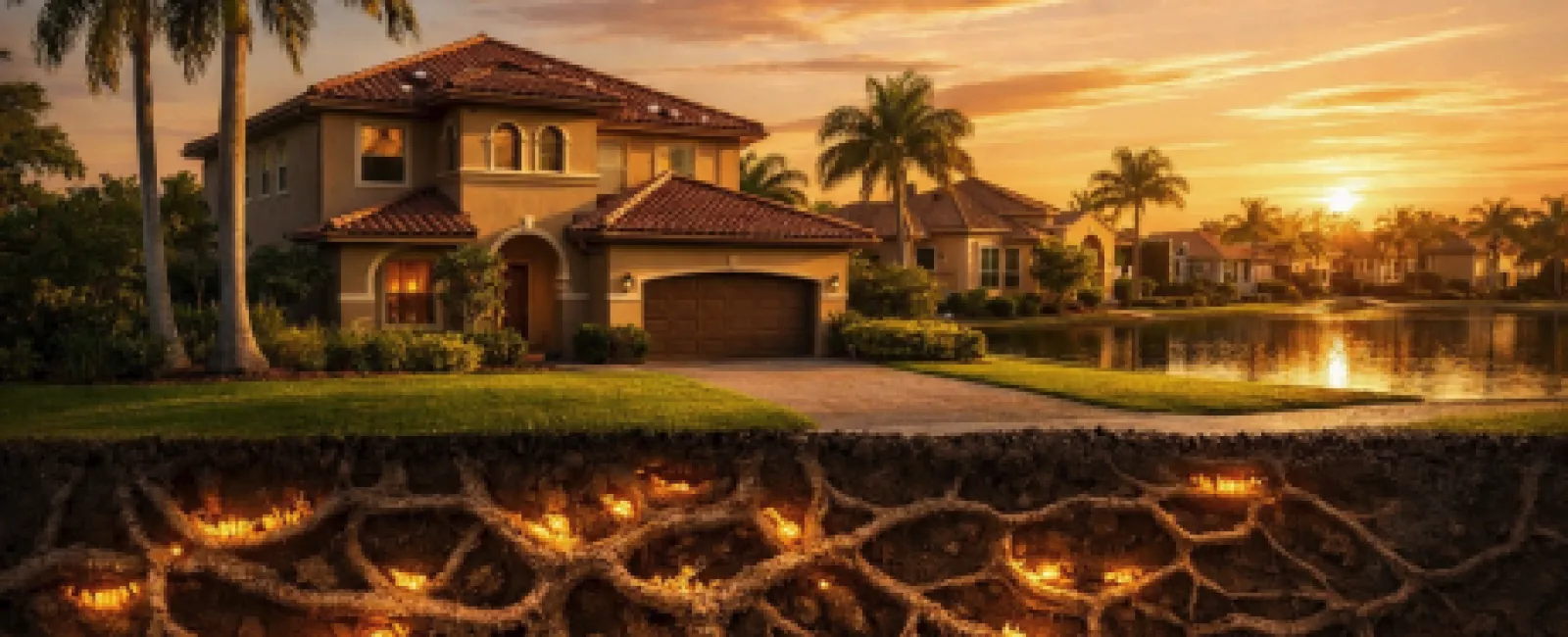
If you've been talking to neighbors lately (at the park, at a block party, at a school pickup), there's a good chance termites have come up. Not the ordinary termite conversations South Florida homeowners have had for decades. Something more urgent.
In 2025, researchers at the University of Florida confirmed what many in the pest control industry had suspected: the two most destructive invasive termite species in the world, the Formosan subterranean termite and the Asian subterranean termite, are spreading across Florida faster than previously projected. Both species are now established well beyond South Florida's borders. And here in Miami-Dade and Broward County, they're not just competing. They're interbreeding.
At Royal Pest & Termite, we believe informed homeowners make better decisions about protecting their homes. This isn't fear-mongering. These are the facts, and they matter for anyone who owns property in South Florida.
Why South Florida Is Ground Zero
South Florida holds a distinction no other place on Earth shares: it is the only region where the ranges of both the Formosan and Asian subterranean termites overlap. Our year-round warmth and humidity don't just make these pests comfortable; they also make them more likely to bite. They allow them to thrive without the seasonal slowdowns that limit termite activity in cooler climates.
A University of Florida study projected that by 2040, nearly half of all structures in the South Florida metropolitan area will be at risk of infestation. That projection was based on data that has since been confirmed as conservative: the 2025 research showed both species are spreading faster than the models anticipated. The Formosan termite, now established across most of Florida's coastal counties, could reach the entire state by 2050. The Asian subterranean termite, once thought confined to South Florida, has already spread into counties near Tampa and up the Atlantic coast.
For homeowners in Broward and Miami-Dade County, this isn't a future problem. The front lines are here now.
Meet the Three Threats
1. The Formosan Subterranean Termite
Often called the "super termite" (a nickname it has earned), a single Formosan colony can contain several million individuals and maintain a foraging territory covering an entire city block. While a native subterranean termite colony might consume a few feet of structural wood over the course of a year, a large Formosan colony can cause significant structural damage in as little as six months.
What makes Formosan termites particularly dangerous is their aggression. They don't wait for ideal conditions. They actively bypass physical barriers, build elaborate carton nests inside wall voids, and forage relentlessly around the clock. By the time visible damage appears, the structural loss is typically already severe.
2. The Asian Subterranean Termite
While the Formosan termite has spread widely across Florida, the Asian subterranean termite has a particular affinity for South Florida's tropical climate. This species is known to attack live trees, hollowing them from the inside until they become structural hazards, particularly during hurricane season. They're also harder to detect than Formosan termites because their colonies tend to be smaller and more dispersed, making early identification more difficult.
3. The Hybrid Threat: Why It Changes Everything
This is the development that has researchers most concerned. Studies out of Fort Lauderdale and Miami have confirmed that Formosan and Asian subterranean termites are interbreeding in South Florida. The resulting hybrid colonies grow at roughly twice the rate of either parent species alone, a phenomenon known as "hybrid vigor." They are more resilient, more aggressive, and harder to control than either species alone.
This hybrid threat is not theoretical. It's documented, it's local, and it's one reason termite treatment strategies that worked a decade ago may no longer be sufficient today.
Signs of Termites in Your South Florida Home
Early detection is everything when it comes to invasive subterranean species. The damage accumulates while the colony remains hidden. Here's what to look for:
Mud tubes are pencil-width tunnels made of soil, wood particles, and termite saliva, typically running along foundation walls, concrete blocks, plumbing penetrations, and behind baseboards. Subterranean termites build these to travel between their underground colony and the wood they're consuming. Finding a mud tube is a reliable indicator of active infestation.
Swarmers and discarded wings appear during swarm season, which in South Florida runs from late winter through summer, often triggered by warm evenings following rain. Winged termites, or piles of shed wings near windowsills, doors, and light fixtures, indicate a mature colony nearby that is actively trying to expand.
Hollow-sounding wood is a sign that termites have already consumed the interior of a structural member while leaving the surface intact. Tap along baseboards, door frames, and exposed beams. A papery, hollow sound is a warning sign.
Paint that's bubbling or peeling without an obvious plumbing source can indicate termite activity just below the surface. Moisture from termite galleries builds up behind paint and drywall, mimicking the appearance of a water leak.
Tight-fitting doors and windows that have recently become difficult to open or close can indicate termite-related moisture damage in the framing, particularly in South Florida's older wood-frame homes.
Frass (tiny pellets of wood particles) may appear below wooden furniture or along baseboards and indicate drywood termite activity, which is separate from but often co-occurring with subterranean species.
What Are the Worst Termites to Have?
Among the species active in South Florida, the Formosan subterranean termite is widely considered the most destructive on Earth: faster-moving, larger-colonied, and more difficult to eliminate than native subterranean species. The hybrid Formosan-Asian colonies documented in Broward and Miami-Dade counties represent an escalation beyond even the Formosan alone. If you have confirmed the presence of invasive subterranean termites in your home, waiting is not a neutral option. The damage compounds quickly.
Why Your Home Insurance Won't Cover This
This surprises many homeowners: standard homeowner's insurance policies almost universally exclude termite damage. Insurers classify it as a preventable maintenance issue rather than a sudden, accidental loss, which means tens of thousands of dollars in structural repair costs fall entirely on the homeowner.
In South Florida, where invasive termite pressure is among the highest in the country, termite control is not a discretionary expense. It's part of responsible homeownership. The cost of annual prevention is a fraction of what structural remediation costs after an established infestation.
Is Fumigation Always Necessary?
Not always, and a trustworthy pest control company will tell you that upfront.
For subterranean termites, the primary treatments are liquid soil barriers and baiting systems. Liquid treatments create a protective zone around your foundation that kills termites on contact as they tunnel toward your home. Baiting systems use slow-acting toxicants that foragers carry back to the colony, eventually eliminating the queen and collapsing the entire population, including the ones you can't see.
Termite fumigation (tenting the structure) is the standard treatment for widespread drywood termite infestations, which live entirely within the wood they consume and are not reached by soil treatments. Many South Florida homes have both subterranean and drywood termites simultaneously, which requires a coordinated approach.
The right treatment depends on what you actually have, which is why a thorough inspection comes first, not a sales pitch.

How to Protect Your Home: Royal Pest & Termite's Approach
When you realize your home might be at risk, you need a team that gives you a straight answer, not an upsell.
In-house fumigation, never subcontracted. Many pest control companies in South Florida sell fumigation services and then hire a third-party tenting crew to do the actual work. At Royal Pest & Termite, our fumigation is performed by our own licensed technicians using our own equipment. That means direct accountability at every step, not a hand-off to a crew we don't supervise.
Pet-safe and family-safe products. We use low-toxicity, professional-grade products that are tough on termites and safe for the people and pets who live in your home. Once treatments have dried or the recommended re-entry window has passed, your family returns to a normal, healthy environment.
State-licensed technicians. Termite treatment technology evolves, particularly as invasive species like the Formosan-Asian hybrid present new challenges. Our technicians are state-licensed and receive ongoing training specifically on invasive species behavior and updated treatment protocols.
No guesswork, no hidden fees. We provide a clear, upfront assessment and explain what we found and why we're recommending it. You understand the plan before anything is signed.
Royal Pest & Termite is locally owned, based in Miramar, and has been serving South Florida homeowners since 2014. Our general pest control services extend beyond termites to the full range of South Florida pest challenges, handled in-house, every time.
A Simple, Low-Pressure Path to Protection
If you're concerned about invasive termites in your home, the process is straightforward:
- Free inspection. We provide a thorough assessment of your home's interior and exterior. No hidden fees, just an honest evaluation of what's there and what's at risk.
- Customized defense plan. Every home is different. Whether you need a preventative baiting system, a liquid soil barrier, or a full fumigation, we explain the reasoning behind the recommendation in plain language.
- Professional implementation. Our licensed technicians execute the plan using the most effective and appropriately safe products available.
- Ongoing protection. Termites are a year-round threat in South Florida. Maintenance plans ensure that once they're eliminated, they stay that way, and new pressure from neighboring properties is addressed before it becomes a problem inside your walls.
Frequently Asked Questions
How often should I have my home inspected for termites in South Florida? At a minimum, once per year. Given how quickly Formosan and hybrid subterranean termites can cause structural damage, an annual professional inspection is the baseline, not the ceiling. Homes adjacent to wooded lots, canals, or with older wood framing should consider twice-yearly inspections.
How do I know if termites are in my walls? Mud tubes along the foundation or baseboards, hollow-sounding wood when you tap structural members, and bubbling or peeling paint without a plumbing source are the most reliable indicators. Swarmers or discarded wings near light fixtures during spring and summer are another strong signal. If you're seeing any of these, don't wait. Subterranean termites work continuously.
Are subterranean termites the only threat in South Florida? No. Drywood termites are also prevalent throughout the region and present a different kind of infestation. They live entirely inside the wood they consume, leave no mud tubes, and require different treatment than subterranean species. Many South Florida homes have both. A thorough inspection identifies which species are present and what each requires.
What's the difference between Formosan and native subterranean termites? Colony size and speed of destruction, primarily. Native subterranean termite colonies typically number in the hundreds of thousands. A Formosan colony can reach several million, with the foraging territory and destructive capacity to match. A Formosan infestation that goes undetected for 2 to 3 years can cause structural damage that costs tens of thousands of dollars to repair.
Don't Wait for the Damage to Show Up
The challenge with invasive subterranean termites is that they're expert concealers. By the time you see evidence (a mud tube, a soft spot in the floor, a door that won't close right), the colony has usually been active for months or years. In South Florida, where Formosan termites and their hybrids are under no seasonal pressure to slow down, that damage compounds year-round.
A free inspection costs you nothing. What it gives you is a clear picture of what's in your home and what to do about it.
Call Royal Pest & Termite at (754) 202-4605 or schedule your free inspection online. Our technicians serve communities throughout Broward County and surrounding South Florida, and we'll give you a straight answer about what we find.
We serve Miramar, Pembroke Pines, Davie, Hollywood, Fort Lauderdale, Boca Raton, South Palm Beach County, and most of Broward County, FL. We also service select areas in northern Miami-Dade County. Call us to confirm availability at your address.