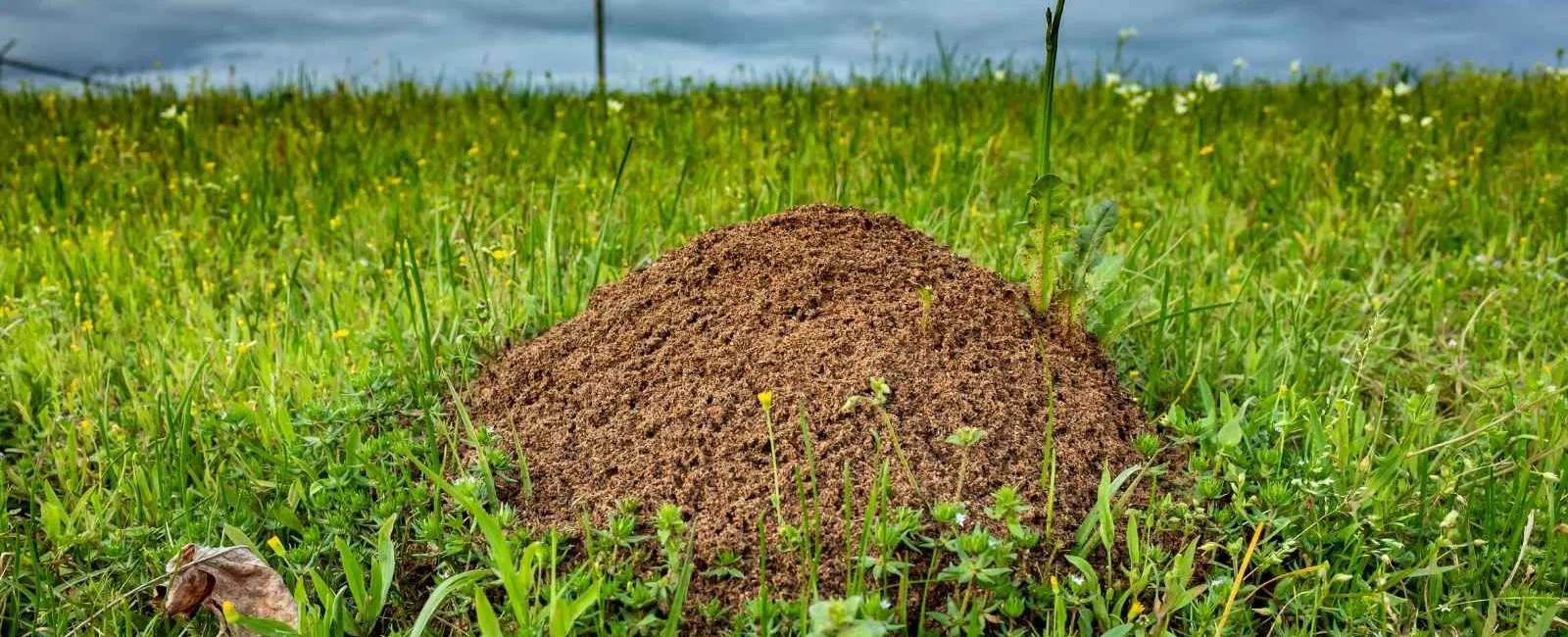
Red imported fire ants are established throughout Florida and are one of the most common yard pests in South Florida's residential communities. They build mounds in lawns, landscaping beds, along driveways and sidewalks, and in areas adjacent to structures. Their sting is medically significant; fire ant stings can cause anaphylactic reactions in sensitive individuals. This makes control a practical health concern, particularly in yards where children and pets spend time.
Effective fire ant control in South Florida requires an approach calibrated to the region's year-round climate and the red imported fire ant's specific biology.
Identifying Fire Ant Mounds
Fire ant mounds in South Florida are typically dome-shaped, composed of loose, worked soil, with no visible opening at the top. The entrance holes are located underground and around the perimeter of the mound, not on its surface. This is distinct from many native ant species that build mounds with visible central openings.
Mound size varies considerably. In South Florida's soft, moist soil, mounds can range from a few inches high in newly established colonies to 12 to 18 inches in large, mature colonies. Mounds tend to be flatter and wider when located in compacted soil or under mulch. After rain, fire ant mounds are often rebuilt rapidly; a mound that appears to have been washed away can be reconstructed within 24 to 48 hours.
Fire ants are highly aggressive when their mound is disturbed. Workers swarm quickly onto anything contacting the mound surface and sting repeatedly. Unlike honey bees, fire ants are not limited to a single sting. Each worker can sting multiple times, and large numbers of workers respond simultaneously to mound disturbance. Stings cause an immediate burning sensation followed by the development of fluid-filled pustules within 24 hours, which are characteristic of fire ant stings and not produced by most other ant species.
Why South Florida Has Year-Round Fire Ant Pressure
Red imported fire ants are native to South America and were introduced to the United States through the port of Mobile, Alabama, in the 1930s. They have since spread throughout the Southeast and are now well-established across all of Florida.
In northern states, fire ant activity slows significantly during winter as soil temperatures drop. Colonies move deeper into the soil during cold periods, and surface activity decreases. In South Florida, where soil temperatures remain warm year-round, fire ant colonies remain active in every month of the year. Queens continue producing eggs without seasonal interruption, and new satellite colonies are established continuously.
Several conditions specific to South Florida residential properties create high fire ant pressure:
- Irrigated lawns. Fire ants prefer moist soil for colony establishment. South Florida's irrigated residential lawns maintain consistently moist soil conditions year-round, making them the primary habitat for fire ant colonies in residential neighborhoods.
- Dense residential proximity. Fire ant colonies spread by mating flights and by budding. Queens leave an existing colony with a group of workers to establish a new satellite colony nearby. In South Florida's densely developed neighborhoods, treated properties are continually under pressure from reinfestation by colonies on adjacent lots.
- Open, sunny areas. Fire ants preferentially colonize open, sunny areas with moist soil. Sunny lawn areas, landscaping beds, and edges along driveways and sidewalks are the most common mound locations in Broward County residential yards.
The Two-Step Fire Ant Control Method
The most effective approach to residential fire ant control combines two components: broadcast bait treatment across the entire yard, followed by individual mound treatment for active mounds.
This approach is the standard recommended by the University of Florida IFAS Extension and is significantly more effective than mound-only treatment applied without broadcast bait.
Step 1: Broadcast bait application.
Fire ant bait products contain a slow-acting insecticide or insect growth regulator (IGR) carried in a food attractant. Foraging fire ant workers collect the bait and carry it back to the colony, where it is distributed to other workers and queens through food sharing. The delayed action of the toxicant allows the bait to spread through the colony before workers begin dying, which is what makes bait treatment effective against the queen rather than just the visible workers.
Broadcast bait is applied across the entire lawn and treatment area, not just to visible mounds. This addresses all colonies in the yard, including those without yet-visible surface mounds, and reduces the overall colony density on the property.
Timing matters significantly. Fire ant foraging activity peaks when soil temperatures are between 70 and 95 degrees Fahrenheit. In South Florida, this is most reliably the case in late morning to midday. Bait applied when ants are not actively foraging is not collected and provides no control. Bait should also be applied when the lawn is dry, and no rain is expected for at least 24 to 48 hours, as moisture rapidly degrades bait attractiveness.
Step 2: Individual mound treatment.
After broadcast bait application, individual mound treatment addresses any large, active mounds that require a more rapid knockdown. Mound treatments include:
- Contact insecticide drenches are applied directly to the mound, penetrating to the queen chamber
- Granular insecticides applied around and over the mound surface and watered in
- Mound injection of liquid insecticide for large or difficult-access mounds
Individual mound treatment provides faster results than bait alone, but does not address the full colony network on the property the way broadcast bait does. Using both together produces the most thorough and durable control.
Why DIY Fire Ant Treatments Often Fail
Fire ant control is one of the most common DIY pest control failures in South Florida. Several factors account for inconsistent results with retail products.
- Contact insecticides are applied without bait. The most common DIY approach is applying a contact insecticide drench directly to visible mounds. This kills the workers present at the surface and in the upper mound galleries but rarely reaches the queen chambers deep in the soil. The colony survives, relocates slightly, and rebuilds the mound within days. Homeowners who drench mounds repeatedly without bait treatment typically see the same mounds reappear within a week.
- Hot water and household remedies. Home remedies, including boiling water, dish soap, and diatomaceous earth, applied to mounds produce limited and inconsistent results. Boiling water kills workers in the upper mound but rarely penetrates to the queen depth, requires large volumes of water, and scalds the surrounding turf. These approaches are not reliable for established colonies.
- Incorrect bait timing. Retail bait products work only when applied during active foraging periods. Bait applied in the early morning when the soil is cold, during rain, or when ants are not foraging is simply not collected and has no effect. Homeowners who apply bait at the wrong time often conclude the product doesn't work rather than identifying the timing issue.
- Reinfestation from adjacent properties. Even effective treatment of a property is subject to rapid reinfestation in South Florida's densely settled neighborhoods. A yard fully cleared of fire ants can have new mounds appear within weeks from colonies on neighboring properties. Ongoing maintenance treatment, rather than a single application, is necessary to maintain control.
Fire Ant Stings: Health Considerations
Fire ant stings are the primary health concern associated with fire ant infestations in residential yards.
The sting produces an immediate burning sensation. A fire ant attacking a target typically grasps the skin with its mandibles, pivots, and delivers multiple stings in a circular pattern. Within 24 hours, characteristic fluid-filled pustules develop at each sting site. In individuals without known sensitivity, stings cause localized pain and itching that resolves within several days.
In individuals with fire ant venom hypersensitivity, stings can trigger systemic allergic reactions, including anaphylaxis, which is a medical emergency. People with known allergies to bee or wasp venom may also be sensitive to fire ant venom. If someone is stung and develops symptoms including hives, swelling of the throat, difficulty breathing, dizziness, or a rapid drop in blood pressure, call 911 immediately.
Children and outdoor pets are at elevated risk of significant stings due to their proximity to the ground and tendency to accidentally disturb mounds. Fire ant colonies in high-traffic areas of the yard, near swing sets, garden beds, or anywhere children and pets regularly spend time, warrant priority treatment.
Fire Ant Control and Your Lawn
Fire ant treatment products, particularly IGR-based baits, have minimal impact on St. Augustine grass and other South Florida turf species when applied correctly. Broadcast granular bait products do not damage turf.
Some contact insecticide drenches can cause localized turf discoloration or damage if applied in high concentrations, particularly in hot conditions. Professional applications use calibrated rates and appropriate products to minimize turf impact.
The relationship between lawn health and fire ant pressure is also relevant. Thinning, stressed turf provides easier access to soil for colony establishment than a dense, healthy lawn. Our lawn care services maintain the turf density that makes the yard less hospitable to fire ant colonization over time, working in combination with targeted fire ant treatment.
How Often Should You Treat for Fire Ants in South Florida?
Given South Florida's year-round fire ant activity and continuous reinvasion pressure from adjacent properties, a single annual treatment is rarely sufficient to maintain control throughout the season.
Most professional fire ant programs in Broward County use a broadcast bait application twice per year, typically spring and fall, combined with spot mound treatment for any colonies that establish between scheduled applications. Properties with high reinfestation pressure, such as those adjacent to undeveloped land, landscaping heavy common areas, or neighboring lots with visible fire ant activity, may benefit from three scheduled applications annually.
Our ant control services and general pest control programs include fire ant treatment as part of a comprehensive yard protection plan.
Scheduling a Fire Ant Treatment
Royal Pest & Termite is locally owned, based in Miramar, and has treated South Florida yards for fire ants and other pests since 2014. Our technicians assess the extent of fire ant activity on your property and apply a treatment approach matched to your specific yard conditions and reinfestation pressure.
Call us at (754) 202-4605 or schedule a free inspection online.
We serve Miramar, Pembroke Pines, Davie, Hollywood, Fort Lauderdale, Boca Raton, South Palm Beach County, and most of Broward County, FL. We also service select areas in northern Miami-Dade County. Call us to confirm availability at your address.